From blogs to websites, it seems like everyone is creating content to engage, educate, market, and promote. It’s no wonder people suffer from content overload, there’s just so much of it.
How do you make sure your content is communicating effectively and getting noticed? Here are six ways to create better, more engaging content for almost any purpose.
1. Know your audience
Your writing has a purpose, and the purpose is to tell somebody something. Your company needs to engage with many content consumers: customers, sales and marketing specialists, engineers, executives, auditors, investors, and employees. Before you start to write, make sure you have a clear vision of who you’re trying to reach.
Then take it one step further. After writing your piece, put yourself in the place of your target audience and read back through from their perspective. Did you answer all their questions? Did you make any assumptions? Did you include information that they don’t need? On important communications, ask for a review from a member of your target audience. Reaching your audience is key to effective communication.
2. Create an outline
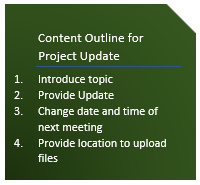
Is taking time to develop an outline always necessary? Even with very brief communications, a single thought or idea can end up in multiple places. You might not even notice it at first but take a close look. An outline helps you stay on track from the simplest to the most complicated of subjects. An outline creates a clear flow and saves time and confusion for the content consumer.
Even the task of writing an email can benefit by creating a simple outline. Try it. You’ll see how a well-constructed outline keeps content from wandering and guides your writing from start to finish.
3. Understand your subject
A lot of professional writers aren’t subject matter experts on the topics they are writing about. However, they make every effort to understand their subjects, research, and talk to experts in the field. They also relentlessly check facts to ensure accuracy. Many technical writers interview users, developers, engineers, and testers to get the information they need. In fact, most writers become users themselves to get details first-hand. Information is worthless if not accurate and true. This is not an area you can skimp on.
4. Use fewer words
Clear communication doesn’t always require creative writing skills. Instead, the best business writers put their efforts into saying what needs to be said in as few words as possible. The fewer words on the page, the less time your audience spends reading. That’s not to say minimalist writing is an easy task. Many writers rely on the skills of a sharp editor when it comes to cutting back, and this can be a painful exercise. Being concise often requires several rewrites and refinements to get the job done. Your readers will appreciate you.
5. Use engaging graphics
Can your communications be faster absorbed with a table or an infographic? If so, by all means make it happen! Employ your local graphic designer if you need to but make sure you have more to offer than large blocks of text. For example, would you rather read…
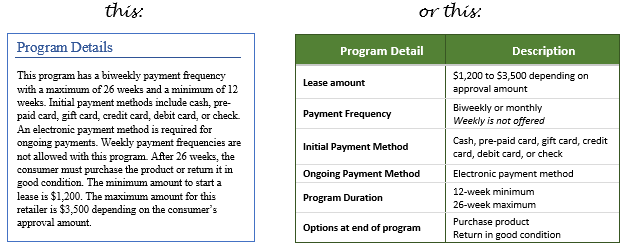
Both formats communicate the same information and take up about the same amount of space, but the one on the right is inherently easier to absorb and has 33 fewer words (about 30% less to read). In every part of your writing, ask yourself if a picture, table, or chart can supplement or replace your written content.
6. Spell- and grammar-check
Finally, you must spell-check your content and correct all grammar flaws. English is a complicated language and all those rules really do serve a purpose. Flawless spelling and grammar improve your writing and lessen the chance for miscommunication. You may have a great piece of writing, but typos get all the wrong kind of attention. And you can’t just rely on the built-in spell-checker. Good writers keep resources on hand—dictionaries, grammar books and websites, and style guides—and check them faithfully.
Almost everyone can benefit from adopting these six guidelines for better content to improve business communications. In fact, as you study other content, make note of where it is lacking. Ask yourself if any of these six techniques was overlooked. This type of analysis will help you identify pitfalls and improve your own content and communications.
 Content Strategy to Effectively Engage