The start of 2020 seemed full of hope with presidential primaries in full swing and a favorable stock market and GDP. But suddenly, we began dealing with a new set of terminology and acronyms that wasn’t exactly commonplace until this decade began. Let’s review a few of those terms that have settled into our psyche over the past couple of months.
General Terms: Outbreak, Epidemic, Pandemic, and Epidemiology
The World Health Organization (see WHO below) declared on January 30 that an outbreak of a new virus in Wuhan, China was a public health emergency of international concern. An outbreak is defined on Wikipedia as a sudden increase in occurrences of a disease in a particular time and place.
That outbreak quickly moved to epidemic status, a disease that affects many people in a community, population, or region. On March 11, the WHO declared the rapidly spreading novel coronavirus a pandemic—a disease likely to spread across multiple countries and continents.
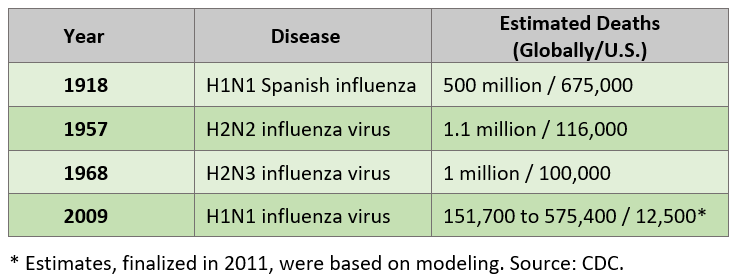
This disease was the 4th pandemic since the deadly 1918 Spanish Flu, which affected one-third of the world’s population (500 million people) according to the Centers for Disease Control (see CDC below).
Lastly, we have become acquainted with the term epidemiology, which means according to Oxford, the branch of medicine which deals with the incidence, distribution, and possible control of diseases and other factors relating to health.
The Disease: Novel Coronavirus and COVID-19
Coronaviruses have been around for a while. That’s why this particular disease is often referred to as the novel coronavirus. The actual virus is called severe acute respiratory syndrome coronavirus 2 or SARS-CoV-2. The disease that it causes is known as coronavirus disease 2019 or COVID-19. It was first reported to the WHO on December 31, 2019 in China. Although similar in symptoms, transmission, and treatment, COVID-19 is not caused by an influenza virus. The novel coronavirus is thought to have originated with bats, or possibly a pangolin.
The Barriers: Social Distancing, Contact Tracing, and PPE
The next few terms entering the vernacular are significant in dealing with major changes affecting daily lives. The first term, social distancing, has become a daily topic, whether you are deciding to attend a wedding, visit grandma, or stand in a line. Handshakes and hugs have been replaced with nods and elbow bumps. Social distancing, also called physical distancing, is defined on Wikipedia as a set of non-pharmaceutical interventions or measures taken to prevent the spread of a contagious disease by maintaining a physical distance between people and reducing the number of times people come into close contact with each other. Most people regard social distancing as standing six feet or more apart.
Contact tracing is defined on Wikipedia as follows: In public health, contact tracing is the process of identification of persons who may have come into contact with an infected person and subsequent collection of further information about these contacts.
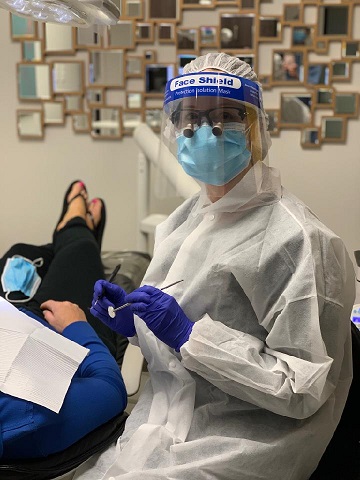
Those who haven’t worked in health care have learned a new term and its associated acronym, personal protective equipment (PPE). For the immediate future, PPE will be donned by everyone we come into close contact with at doctor and dentist offices, hair salons, blood donation centers, and others. The Occupational Safety and Health Administration (OSHA) defines PPE as equipment worn to minimize exposure to hazards that cause serious workplace injuries and illnesses.
Agency Acronyms: CDC, NIH, and WHO
This section describes the agencies we have become familiar with over the past couple of months. If you’re looking for information regarding the pandemic, these are good places to start:
Centers for Disease Control and Prevention (CDC)—The CDC is part of the U.S. Department of Health and Human Resources (HHS). According to its website, the CDC’s role is to detect and respond to health threats and tackle health problems causing death and disability for Americans. It is headquartered in Atlanta, Georgia.
National Institutes of Health (NIH)—Also a part of the HHS, the NIH website says it is the largest biomedical research agency in the world. It is headquartered in Bethesda, Maryland.
World Health Organization (WHO)—Headquartered in Geneva, Switzerland, the primary role of the WHO is to direct and coordinate international health within the United Nations system. Its main areas of work include communicable and noncommunicable diseases, preparedness, surveillance and response, and corporate services.
The Remedies: Antiseptic versus Disinfectant, and Antibodies
Antiseptics are cleansers for living things; for instance, hands, mouths, and wounds.
Disinfectants, such as bleach, are used for cleaning objects; that is, floors, door handles, light switches, and phones. And not inside bodies.
Antibodies provide protection from disease within the human body. With no vaccine available yet, the best protection is thought to be the presence of antibodies within people who were previously infected with COVID-19. The questions remain that if you test positive for the COVID-19 antibodies does this mean you can’t become ill with the virus, be re-infected, or infect others?
AP Stylebook Changes
Watch for the 2020 edition of the AP Stylebook to be released on May 27. The Associated Press has decided to release its style guide once every two years instead of once a year; this will be the 55th edition. Not too many dramatic changes are in store for this edition and none so far having to do with the novel coronavirus.
- Writers will no longer use the term midnight because people might be confused about which day that represents. So we’ll now use 11:59 p.m. or 12:01 a.m.
- Gender-neutral discussions by AP Stylebook editors failed to determine an acceptable replacement for fisherman. In general, fisher seemed to win out. Do you prefer, “She is a fantastic fisherman!”? Or, “She is a fantastic fisher!”?
- For this next change, I wrote a simple haiku to help me remember:
AP grammar rules.
Do I write, “Pleaded or pled?”
Pled okay, ‘nuf said.
- And finally, preheat is no longer considered redundant. The Associated Press has conceded to allow its use in 2020.
 Content Strategy to Effectively Engage